1The Problem
The phase-field crystal model describes a crystal by a density field that oscillates on the scale of the atomic spacing. A homogeneous state with small noise is unstable at these parameters and orders into a density wave with wavenumber about one. The mean density is conserved.
2The Problem File
The sixth-order equation becomes two equations of at most fourth order, in ψ and the
chemical potential μ. The SBDF2 scheme treats the linear part implicitly and the cubic term
explicitly, with a linear stabilization Cs*psi added implicitly and subtracted explicitly,
so the implicit matrix is constant. Jacobi-GMRES struggles with this sixth-order operator, so the
solver factorizes it instead (2 factorizations in the whole run). The factorization dominates
the first steps; after it each step takes about a second.
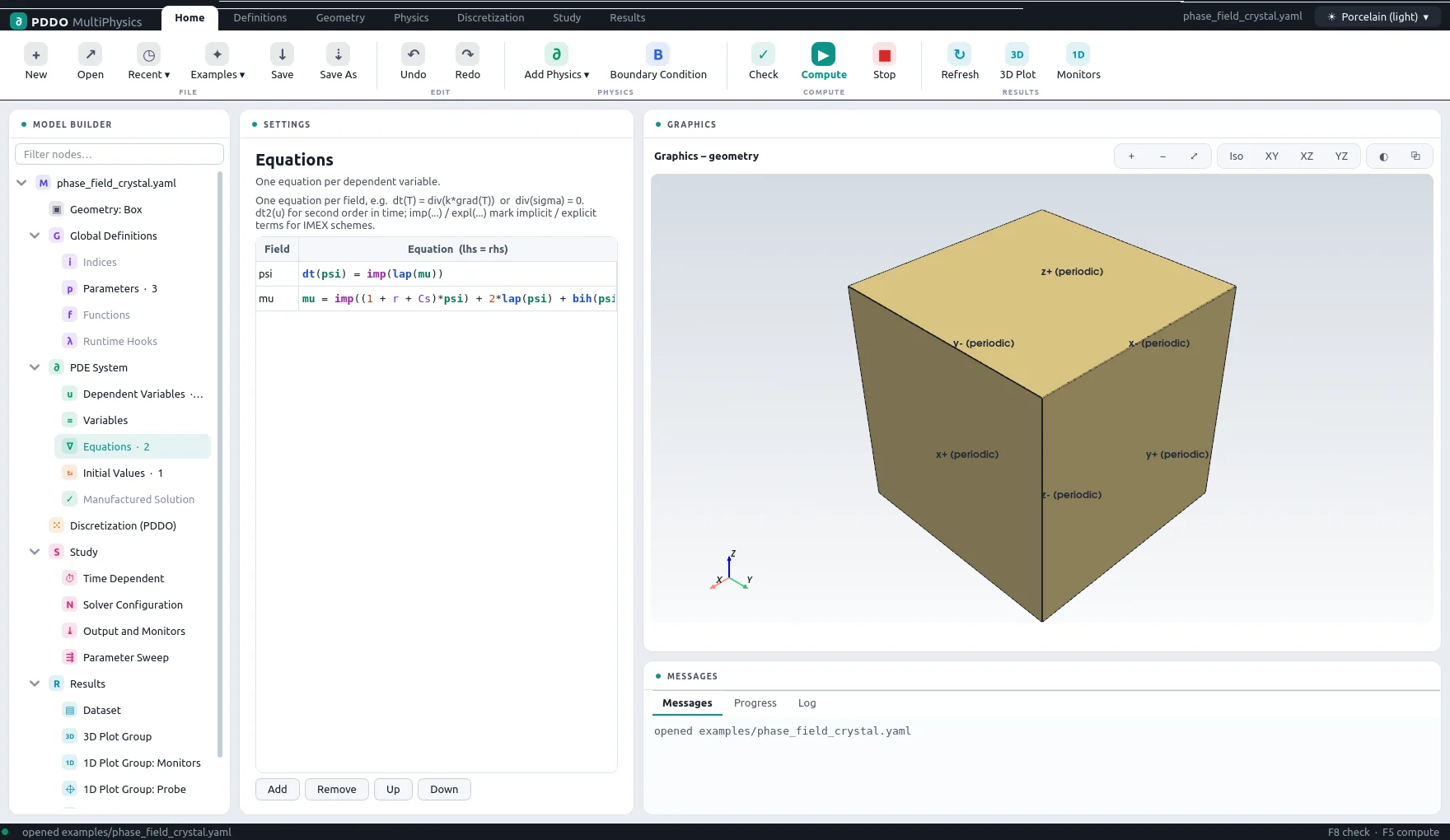
The complete problem file, examples/phase_field_crystal.yaml
# Phase-field crystal (Swift-Hohenberg conserved dynamics, 6th order in space):
#   dt(psi) = lap(mu),   mu = (r + (1 + lap)^2) psi + psi^3
#           = (1 + r) psi + 2 lap(psi) + bih(psi) + psi^3
# written as a mixed system (highest derivative 4: PDDO order 4). A homogeneous state
# psi0 = -0.25 with noise crystallizes into a periodic density wave with wavenumber ~1
# (lattice spacing 2 pi); the mean of psi is conserved. IMEX (SBDF2): the cubic term is
# explicit with a linear stabilization Cs*psi (implicit - explicit), so the implicit matrix
# is constant.
"k">name: phase_field_crystal
"k">domain:
  "k">size: [25.1327, 25.1327, 25.1327]      # 4 wavelengths (8 pi)
  "k">n: [32, 32, 32]
  "k">periodic: true
"k">parameters:
  "k">r: -0.35
  "k">psi0: -0.25
  "k">Cs: 2.0                          # linear stabilization of the explicit cubic term
"k">fields:
  "k">psi: scalar
  "k">mu: scalar
"k">equations:
  "k">psi: "dt(psi) = imp(lap(mu))"
  "k">mu: "mu = imp((1 + r + Cs)*psi) + 2*lap(psi) + bih(psi) + expl(psi**3 - Cs*psi)"
"k">initial_conditions:
  "k">psi: "psi0 + 0.05*randn()"
"k">time:
  "k">end: 150.0
  "k">dt: 0.5
  "k">scheme: sbdf2                     # linear part implicit, constant matrix
"k">output:
  "k">every: 20
"k">monitors:
  "k">psi_mean: "mean(psi)"
  "k">psi_max: "max(psi)"
  "k">psi_min: "min(psi)"
  "k">energy: "integral(1/2*psi*((1 + r)*psi + 2*lap(psi) + bih(psi)) + psi**4/4)"

3Results
- Nodes
- 32×32×32 = 32,768
- Periodic
- xyz
- PDDO order
- 4, horizon 3.015 Δx
- Time scheme
- sbdf2
- Steps
- 300 × Δt = 0.5
- Newton iterations
- 301
- Factorizations
- 2
- Run time
- 19 min
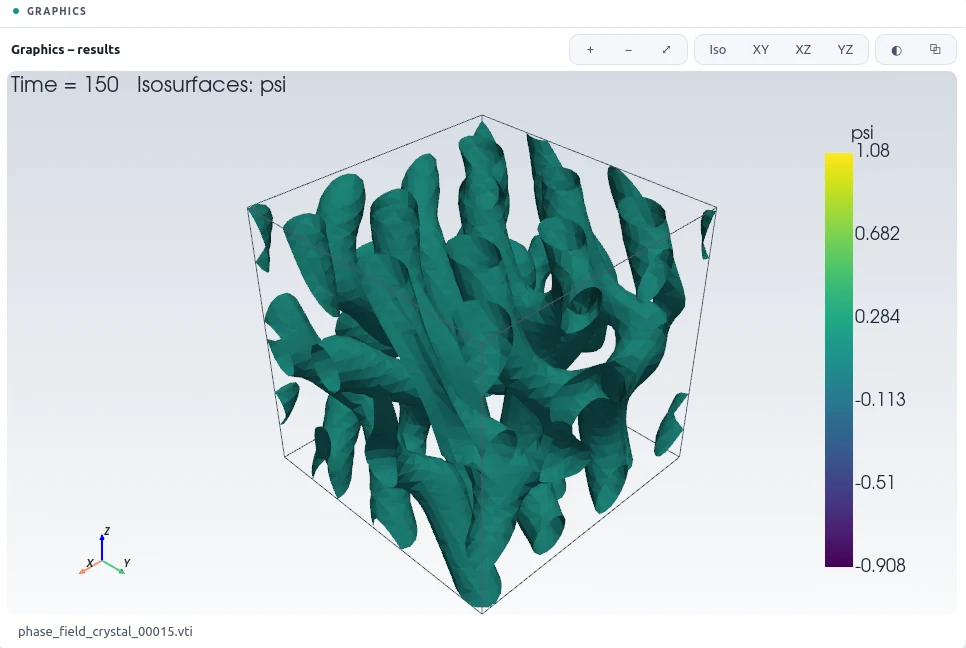
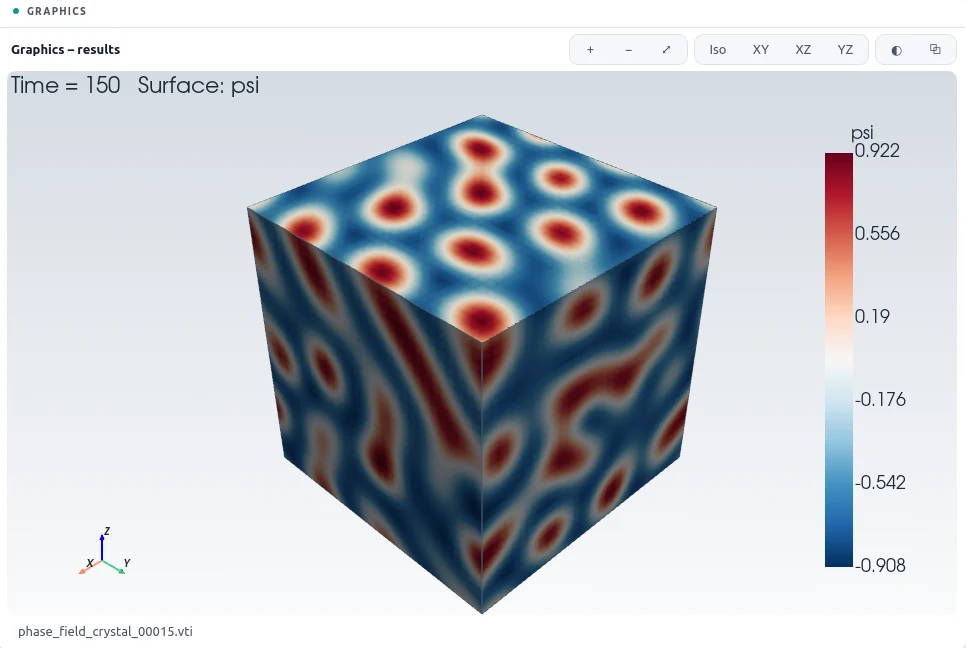
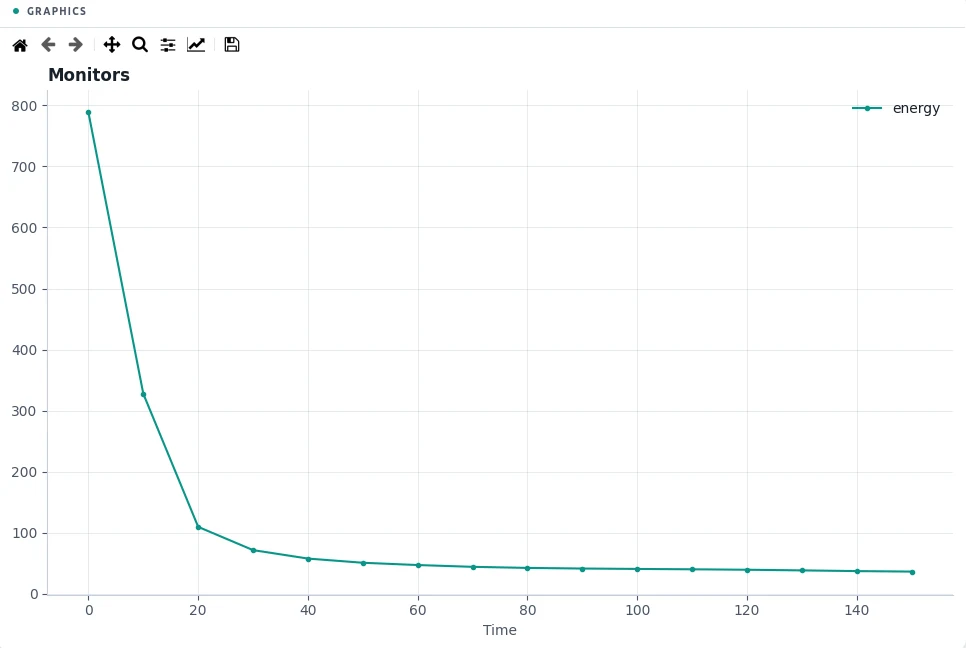
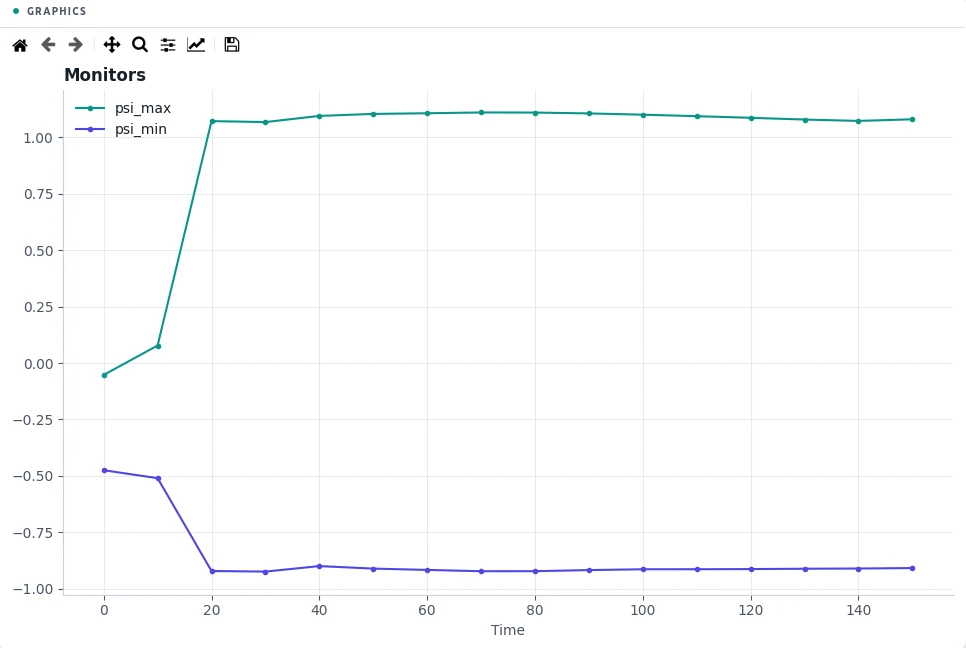
The mean density stays at -0.2498 (change below 1×10⁻¹⁰). The free energy falls from 788 to 36.3 as the density wave forms, and the density oscillates between -0.908 and 1.08. By t = 150 the box is ordered locally into rods and stripes with the expected spacing, but not into one perfect crystal: the energy is still falling slowly as the defects between the differently oriented regions anneal.
4Run It Yourself
The problem file ships with PDDO-MultiPhysics. Open it in the graphical interface and press Compute, or run it from the command line:
python -m pddo_mp gui examples/phase_field_crystal.yaml
python -m pddo_mp run examples/phase_field_crystal.yaml
Results go to results/phase_field_crystal/
next to the problem file: a ParaView time series (.pvd), the monitors as CSV, and the
final state. Any entry can be changed on the command line, for example
--set time.end=75 for a run to half the end time. The user manual
describes every part of the problem file and of the interface.