PDDO-MultiPhysics Examples
Twenty problems that ship with PDDO-MultiPhysics, from a heat equation checked against its exact solution to 41 coupled grain fields. Each page shows the physics, the complete problem file, how it looks in the interface, and the results of an actual run, with the numbers that check it.
Verification
Problems with a known answer. The engine derives the source terms and boundary data from an exact solution, so the reported error is the discretization error alone.
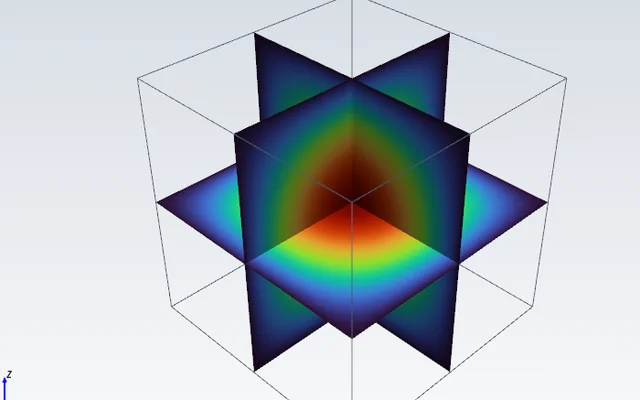
Heat conduction against the exact solution
Transient conduction in a cube, compared at every step with the exact separable solution. A first check of the operators and of the time schemes.
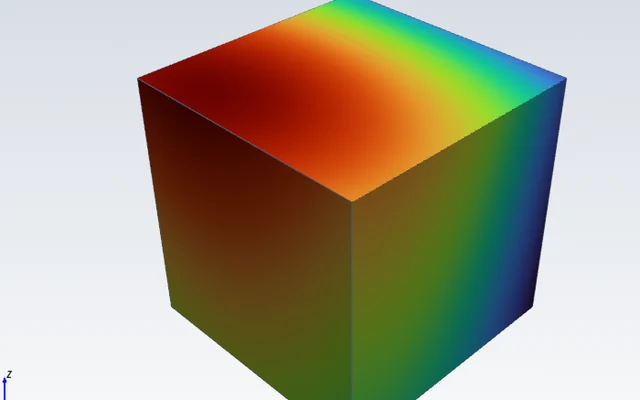
Nonlinear heat conduction with every boundary condition
Temperature-dependent conductivity with Dirichlet, Neumann, Robin and convective boundaries, verified by a manufactured solution.
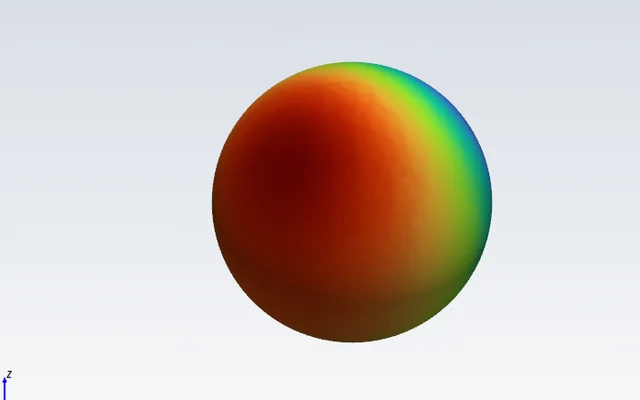
Nonlinear heat conduction in a sphere
The manufactured-solution test on a curved part: a surface-conforming point cloud, true normals, and different conditions on the two halves of the surface.
Heat transfer and thermo-mechanics
Conduction coupled to elasticity, on boxes, imported CAD parts and parts made of several materials.
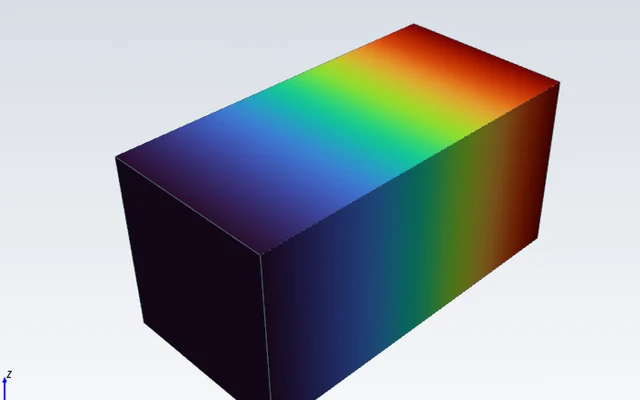
Thermoelastic block heated on one face
Transient conduction coupled to quasi-static thermoelasticity, with convection and traction-free faces. One factorization serves the whole run.
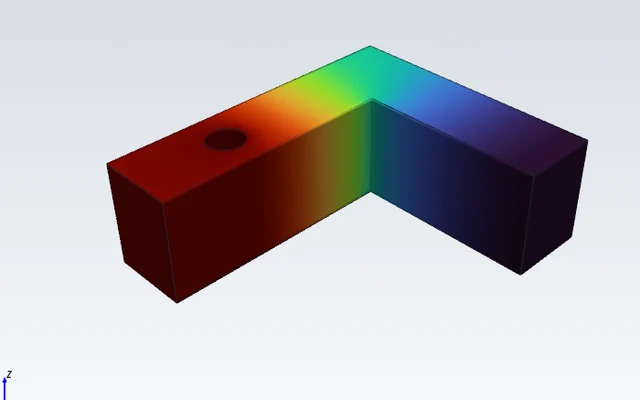
Thermal stress in an aluminium bracket
A STEP part heated through its bolt hole: conditions applied to named CAD faces, convection everywhere else, the back face clamped.
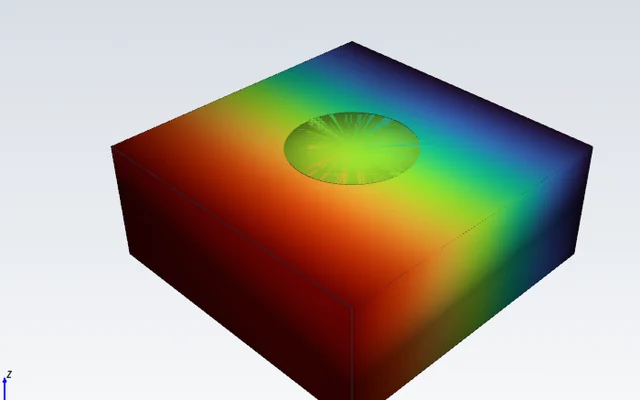
Effective conductivity of a fibre composite
Two materials with a bonded interface: the unit cell of a fibre array, compared with Rayleigh's formula for the effective conductivity.
Solid mechanics
Static and dynamic elasticity, plasticity, viscoelasticity and fracture, each written as constitutive relations in the problem file.
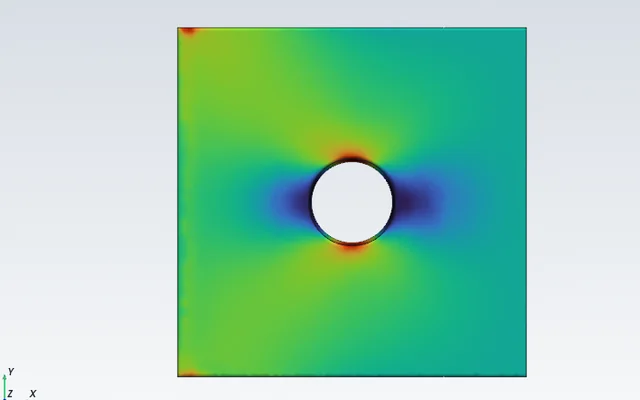
Stress concentration at a hole
A steel plate in tension, imported from STEP, with the point cloud refined locally around the hole where the stress peaks.
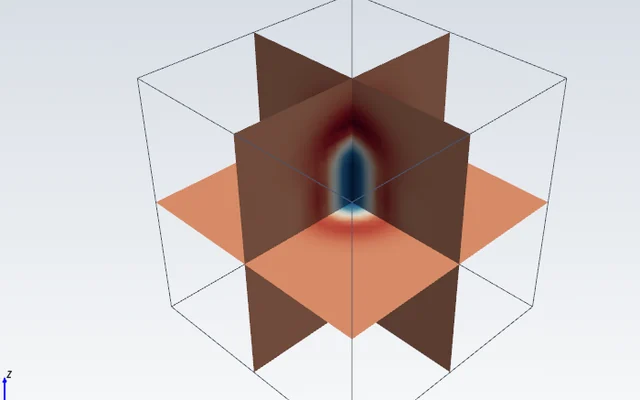
Elastic waves in a block
Elastodynamics with a second time derivative: a displacement pulse released in a clamped block, with the strain and kinetic energy monitored.
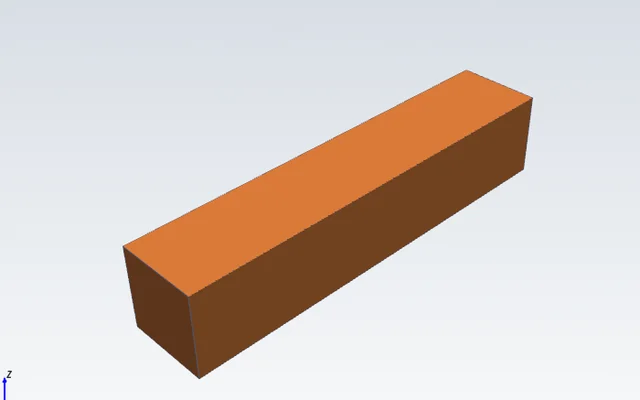
J2 plasticity: loading and unloading a bar
Small-strain plasticity with isotropic hardening, a closed-form return mapping and the consistent tangent, compared with the analytic uniaxial curve.
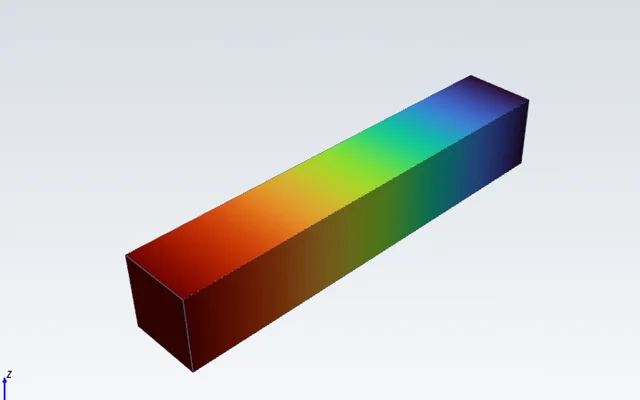
Viscoelastic creep of a bar
A standard linear solid with the viscous strain as a local ODE, under a constant end stress, compared with the analytic creep curve.
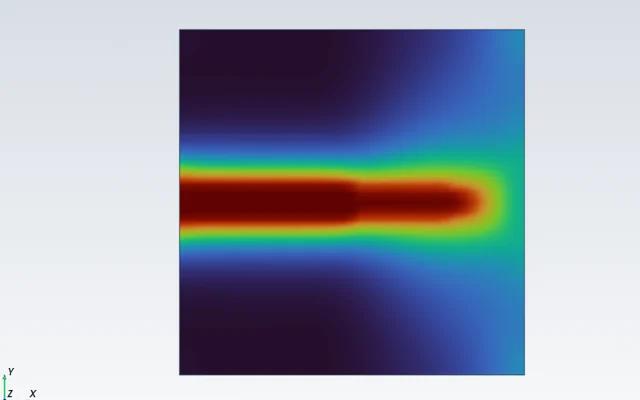
Phase-field fracture of a notched plate
AT2 phase-field fracture with an irreversible history field: the crack grows from the notch and the load drops.
Phase field and microstructure
Phase separation, solidification, crystallization and precipitation, from fourth- and sixth-order equations to 41 coupled grain fields.
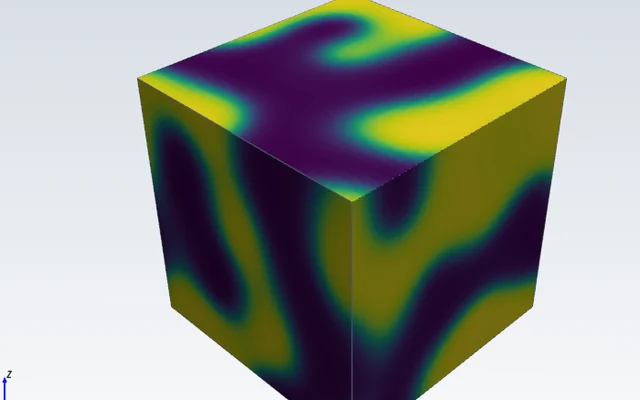
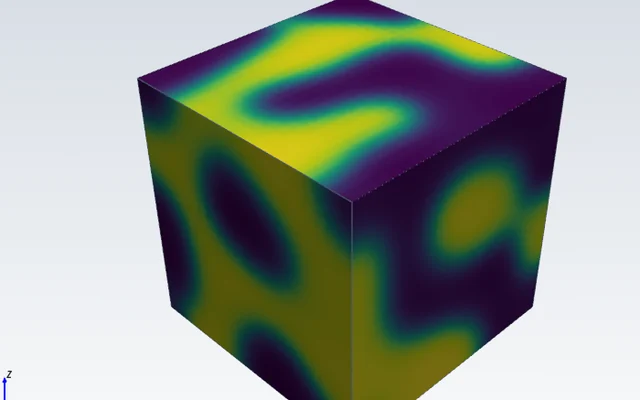
Spinodal decomposition (Cahn-Hilliard)
Fourth-order Cahn-Hilliard in a periodic box: a noisy mixture separates into two interpenetrating phases while mass is conserved.
Cahn-Hilliard in a bounded box
The mixed (c, mu) form with no-flux walls: two second-order equations instead of one of fourth order, and a natural boundary condition for each field.
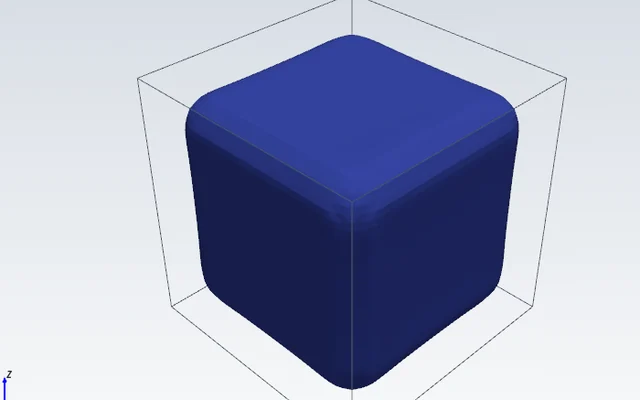
Solidification of an undercooled melt
A phase field coupled to heat with latent heat release: a seed grows into the undercooled liquid and warms it.
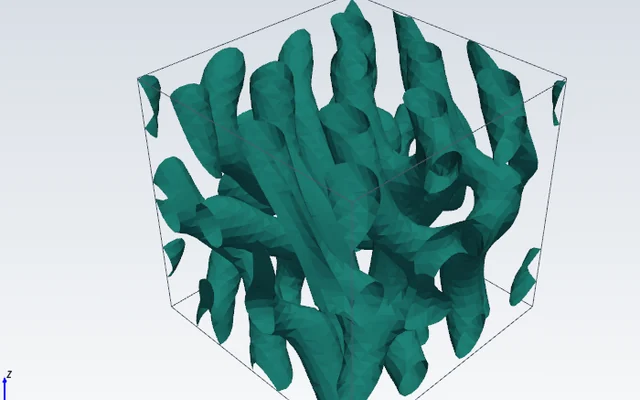
Phase-field crystal
Sixth-order conserved Swift-Hohenberg dynamics as a mixed system: a homogeneous density crystallizes into a periodic lattice.
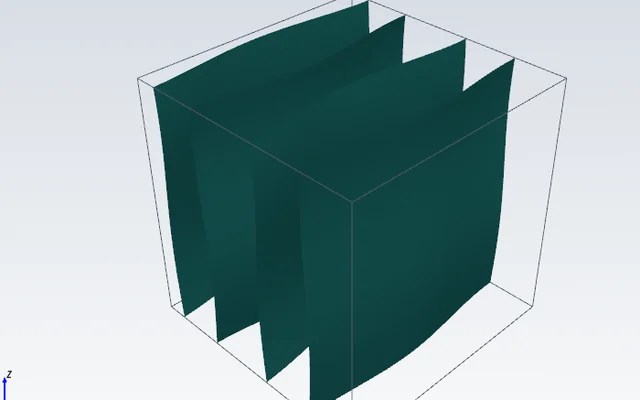
Phase separation with cubic elasticity
Cahn-Hilliard coupled to anisotropic elasticity with a composition misfit: the phases align with the elastically soft cube axes.
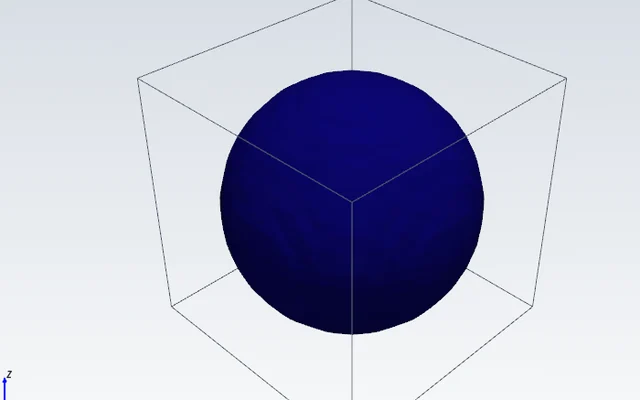
Precipitation driven by a CALPHAD database
A compound grows from a binary liquid during heating; the driving force is computed from a thermodynamic database (.tdb) and tabulated.
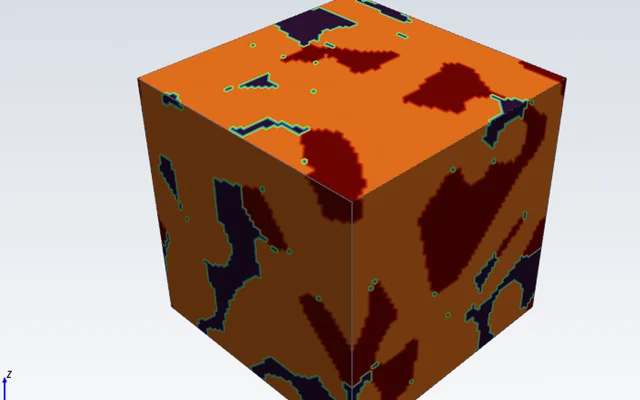
Glass-ceramic crystallization
41 grain fields and a composition field during a heating ramp, with nucleation and phase bookkeeping in Python hooks.
Reaction, diffusion and electrochemistry
Pattern formation and lithium insertion with diffusion-induced stress.
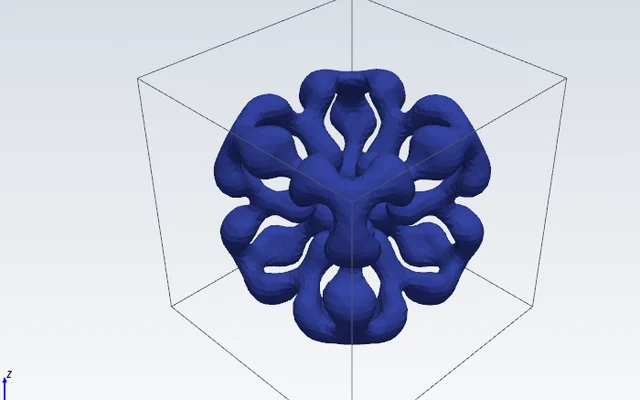
Gray-Scott pattern formation
Two reacting and diffusing species in a periodic box: a seeded cube grows into a self-replicating 3D pattern.
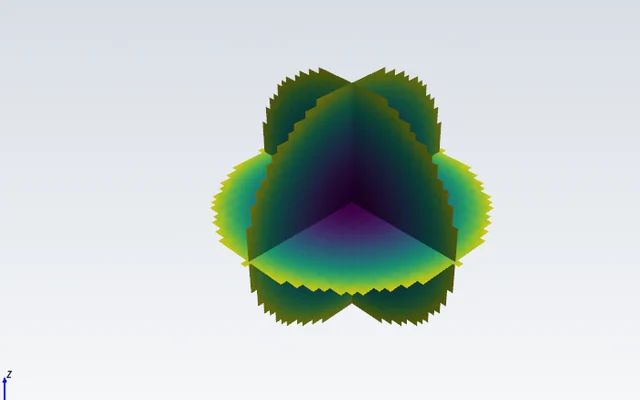
Lithium insertion into an electrode particle
Diffusion with diffusion-induced stress and stress-assisted diffusion, two-way coupled, in a spherical particle charged at constant flux.
Every problem file is in the examples folder of the installation, and the
user manual explains each part of it.
Run times were measured on a 24-core workstation with five threads per run.