1The Problem
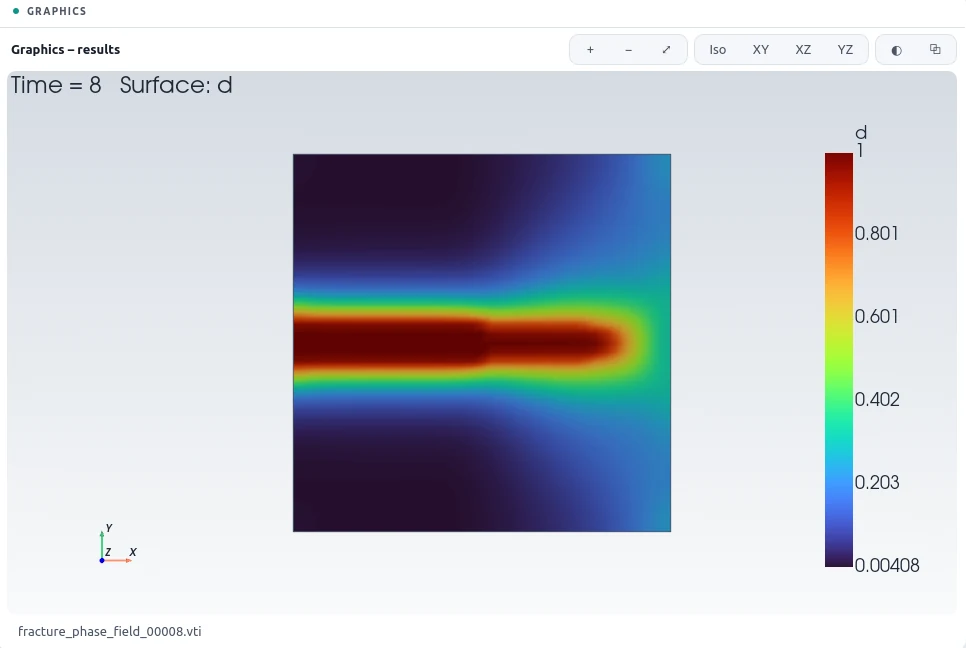
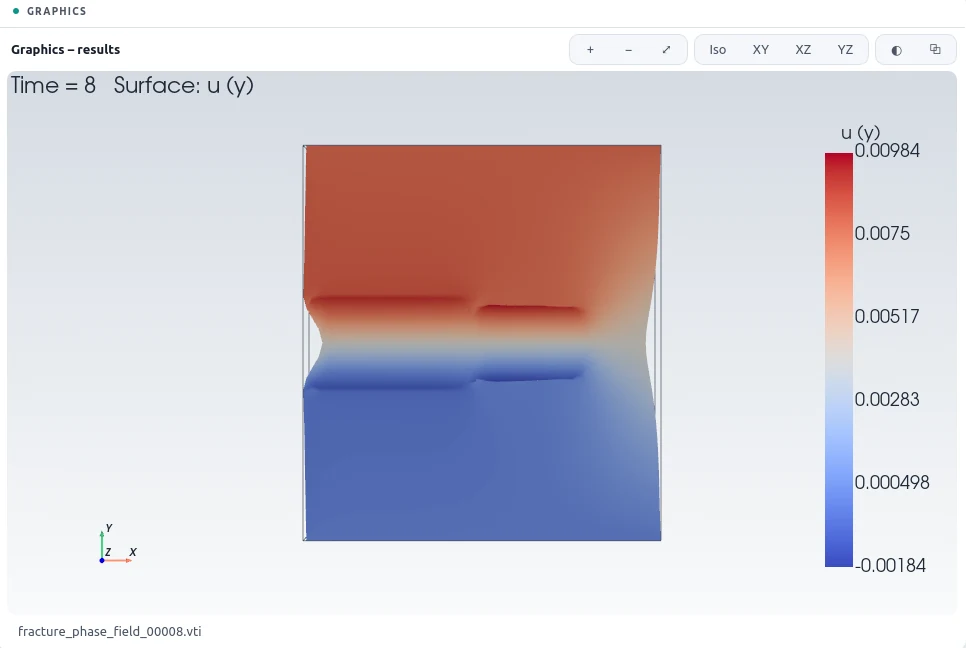
A square plate with a horizontal notch running halfway in from the left is pulled at its top edge while its bottom edge is held. The phase field d, 0 in intact material and 1 in a crack, smears the crack over a regularization length; the elastic stress is degraded where d grows, and an irreversible history field makes sure the crack never heals.
2The Problem File
The history is a field with an update rule, H: {type: scalar, update: "max(H,
psi_plus)"}, applied after every converged step. The notch is not cut out of the geometry: it
is a large initial history along y = 0.5, x < 0.5, so the damage there
starts at one. The top displacement grows linearly with time, and Newton uses a line search.
The complete problem file, examples/fracture_phase_field.yaml
# Phase-field fracture (AT2) - notched plate in tension
# (plane-strain slab: thin, periodic in z). Irreversibility through the history field
#   H = max(H, psi_plus)        (update rule after every step)
# Damage d (stationary):   Gc (d/l - l lap(d)) = 2 (1 - d) H
# Elasticity:              div(sigma) = 0
# Isotropic degradation: sigma = ((1 - d)^2 + k) sigma_0, psi_plus = sigma_0 : eps / 2.
# A volumetric-deviatoric split (Amor: only tension and shear degrade) can be written with
# relations, see tests/test_internal_variables.py; on this notched plate its Newton solve
# still stalls near the crack faces (contact-like switch), even smoothed (C1), with a line
# search and adaptive load steps - an alternate-minimization (staggered u / d) solve is the
# usual remedy (TODO).
# The initial notch (x < 0.5 at y = 0.5) is given as a large initial history.
"k">name: fracture_phase_field
"k">domain:
  "k">size: [1.0, 1.0, 0.125]
  "k">n: [41, 41, 5]
  "k">periodic: [false, false, true]
"k">parameters:
  "k">E: 210.0
  "k">nu: 0.3
  "k">Gc: 2.7e-3
  "k">l0: 0.05                         # regularization length (2 nodes)
  "k">kres: 1.0e-4
  "k">K: "E/(3*(1 - 2*nu))"
  "k">G: "E/(2*(1 + nu))"
  "k">ubar: "1.0e-3*t"                 # top displacement
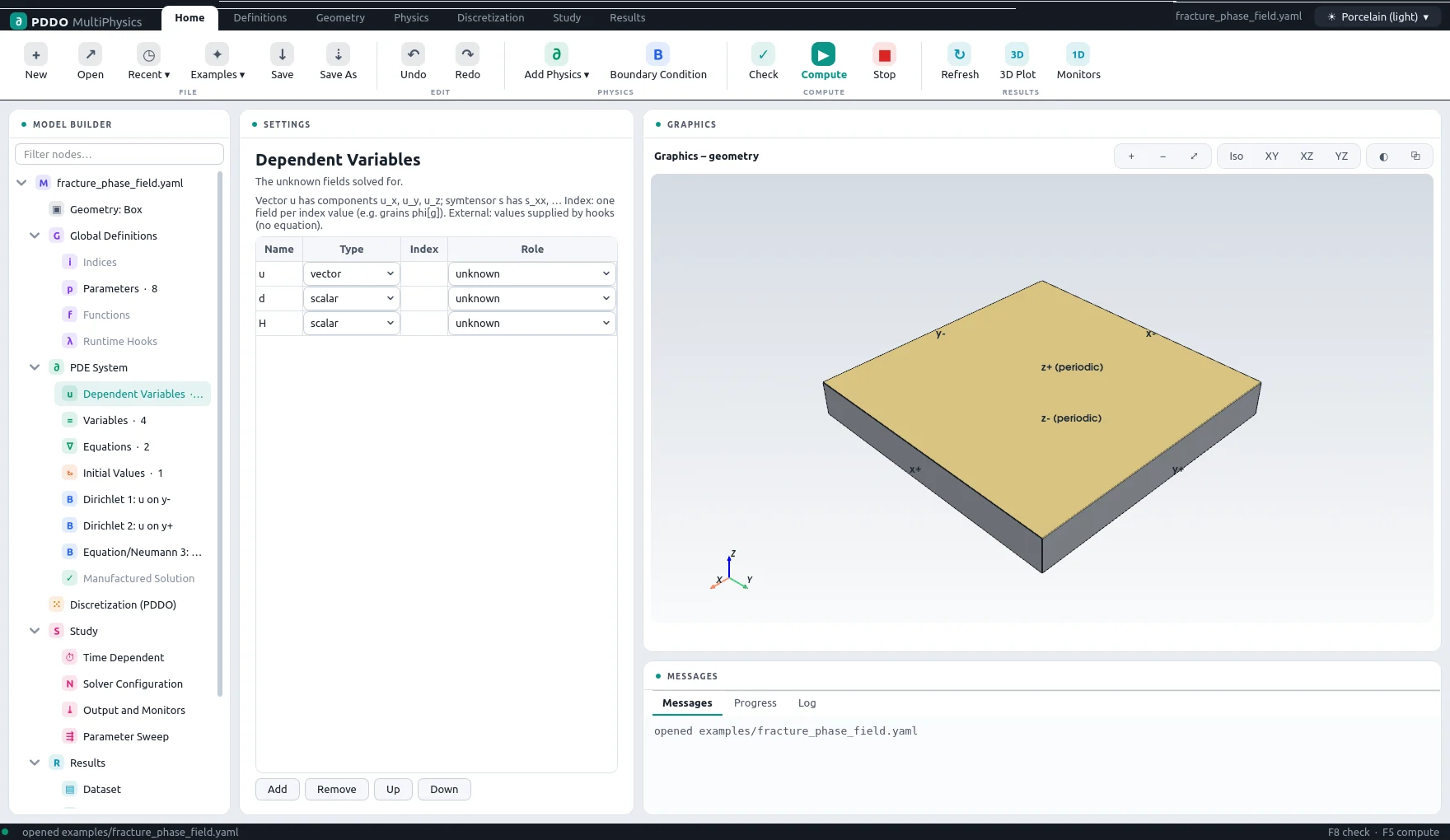
"k">fields:
  "k">u: vector
  "k">d: scalar
  "k">H: {type: scalar, update: "max(H, psi_plus)"}
"k">relations:
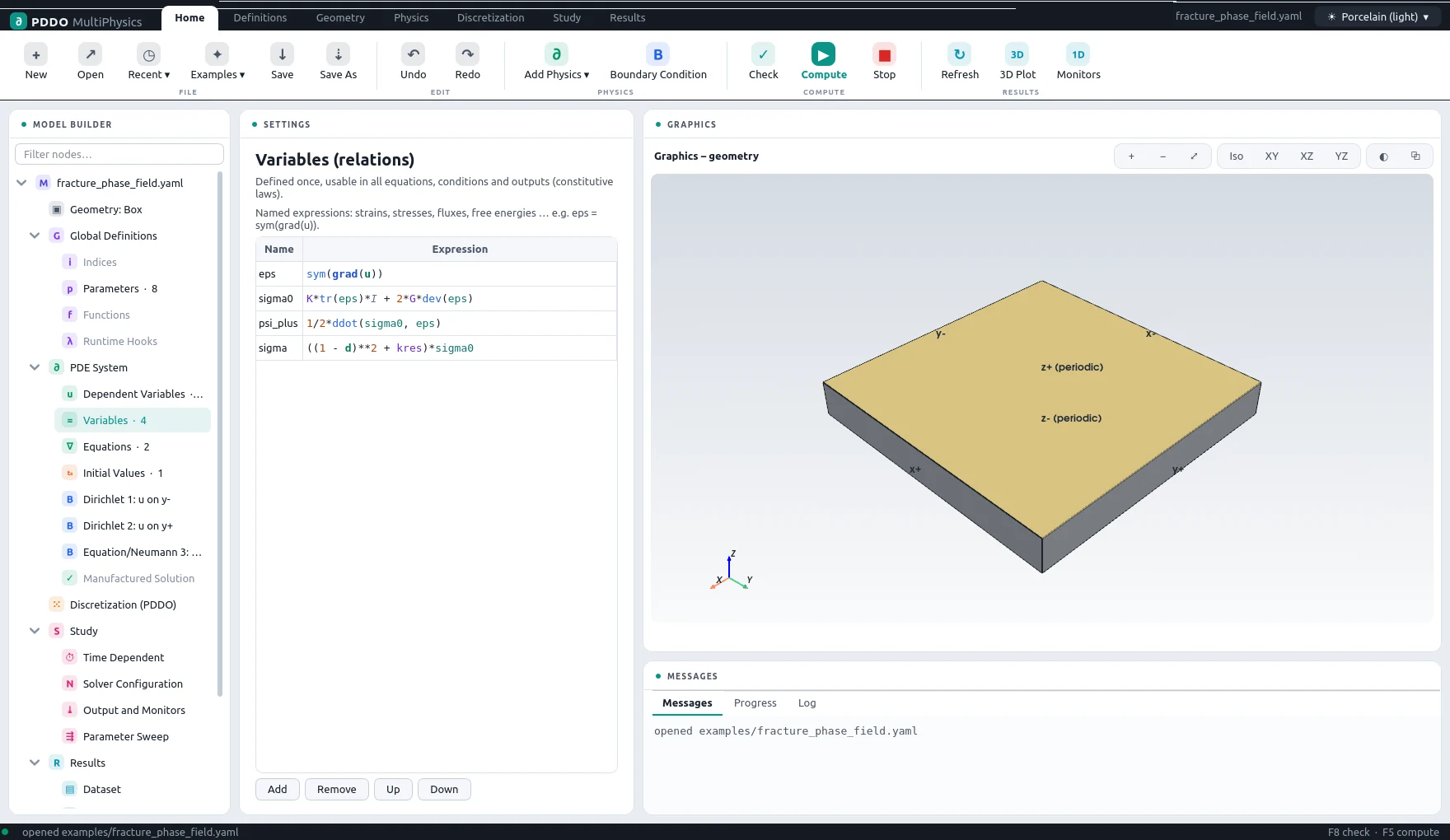
  "k">eps: "sym(grad(u))"
  "k">sigma0: "K*tr(eps)*I + 2*G*dev(eps)"
  "k">psi_plus: "1/2*ddot(sigma0, eps)"
  "k">sigma: "((1 - d)**2 + kres)*sigma0"
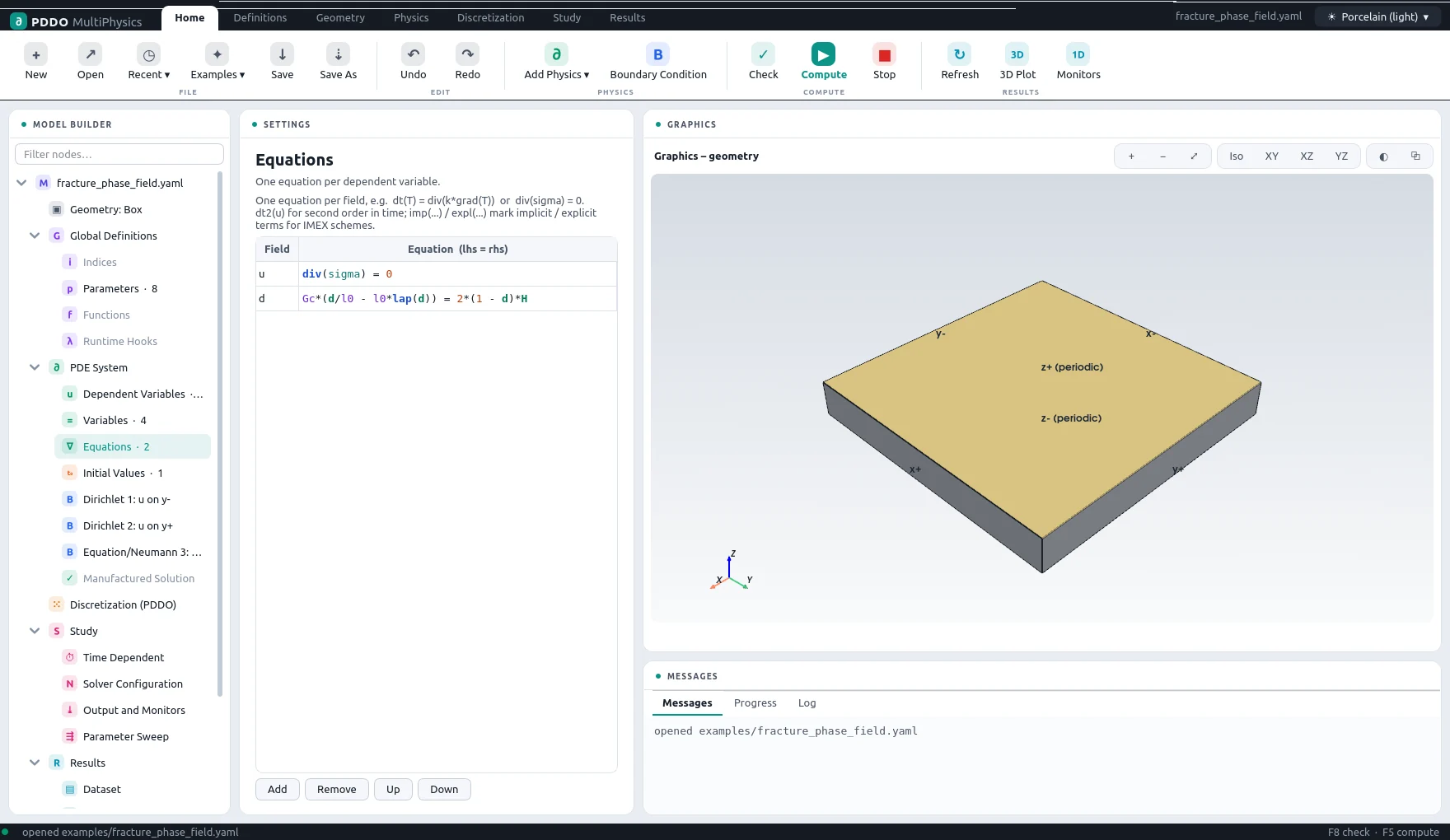
"k">equations:
  "k">u: "div(sigma) = 0"
  "k">d: "Gc*(d/l0 - l0*lap(d)) = 2*(1 - d)*H"
"k">initial_conditions:
  "k">H: "1.0e3*Gc/l0*Heaviside(0.5 - x)*exp(-((y - 0.5)/(0.5*l0))**2)"
"k">boundary_conditions:
  - "k">faces: [y-]
    "k">u: {dirichlet: [0, 0, 0]}
  - "k">faces: [y+]
    "k">u: {dirichlet: [0, "ubar", 0]}
  - "k">faces: all
    "k">u: {equation: "dot(sigma, n) = [0, 0, 0]"}
    "k">d: {neumann: 0}
"k">time:
  "k">end: 8.0
  "k">dt: 0.1
  "k">scheme: backward-euler
"k">solver:
  "k">newton: {line_search: true}
"k">output:
  "k">every: 10
  "k">fields: [u, d, H]
"k">monitors:
  "k">d_max: "max(d)"
  "k">cracked: "mean(Heaviside(d - 0.9))"
  "k">sigma_yy: "mean(sigma[1, 1])"
3Results
- Nodes
- 41×41×5 = 8,405
- Periodic
- z
- PDDO order
- 2, horizon 2.015 Δx
- Time scheme
- backward-euler
- Steps
- 80 × Δt = 0.1
- Newton iterations
- 160
- Factorizations
- 159
- Run time
- 14 min
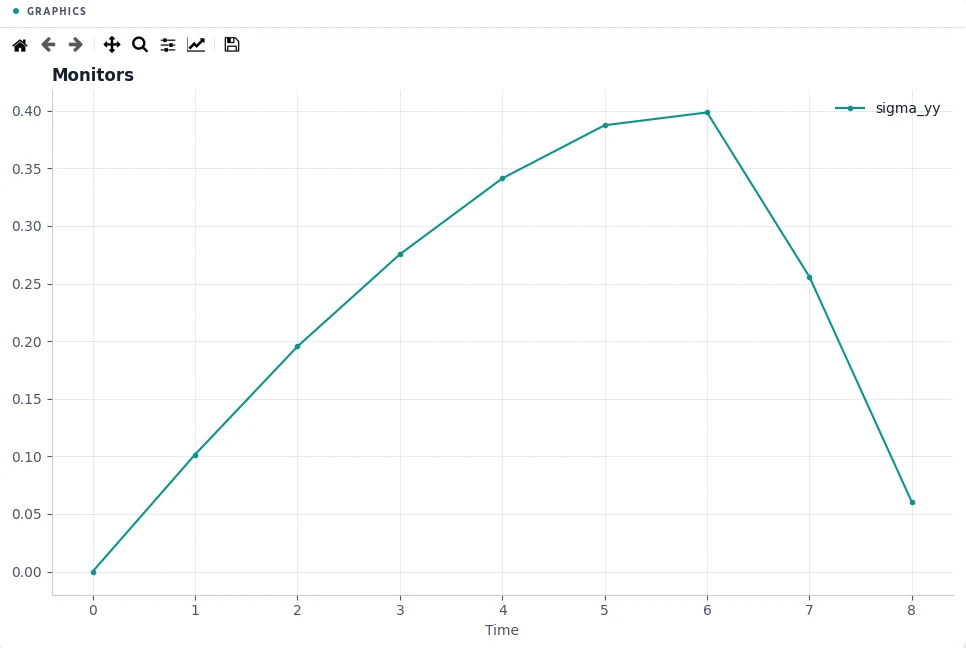
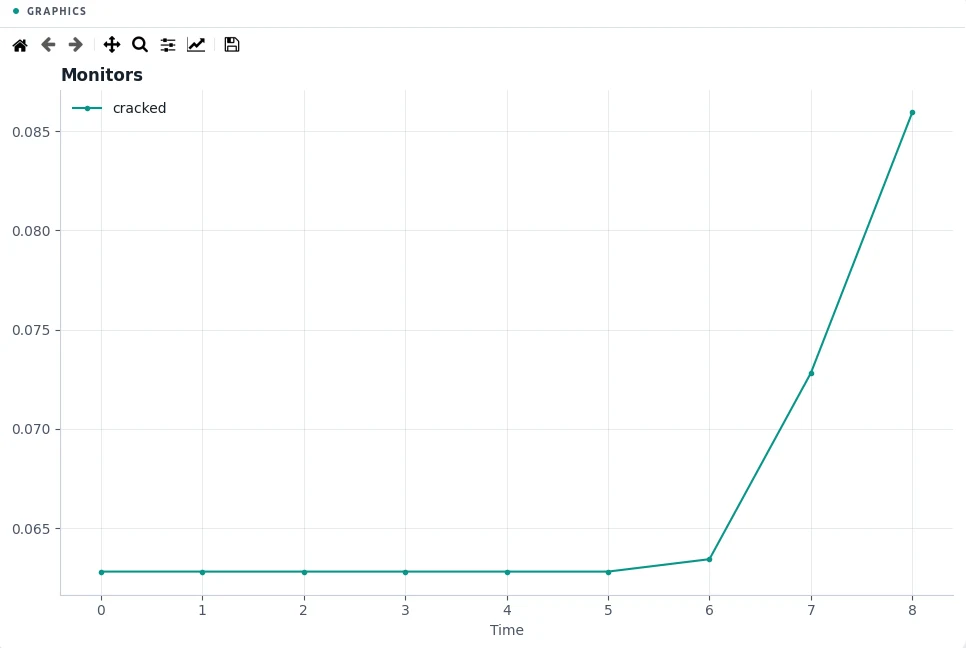
At first the plate responds elastically with the damage confined to the notch (6.3 % of the plate cracked). The mean stress peaks at 0.399 at t = 6.0; then the crack runs from the notch tip, the cracked fraction grows to 8.6 %, and the stress drops by 85 % to 0.060.
4Run It Yourself
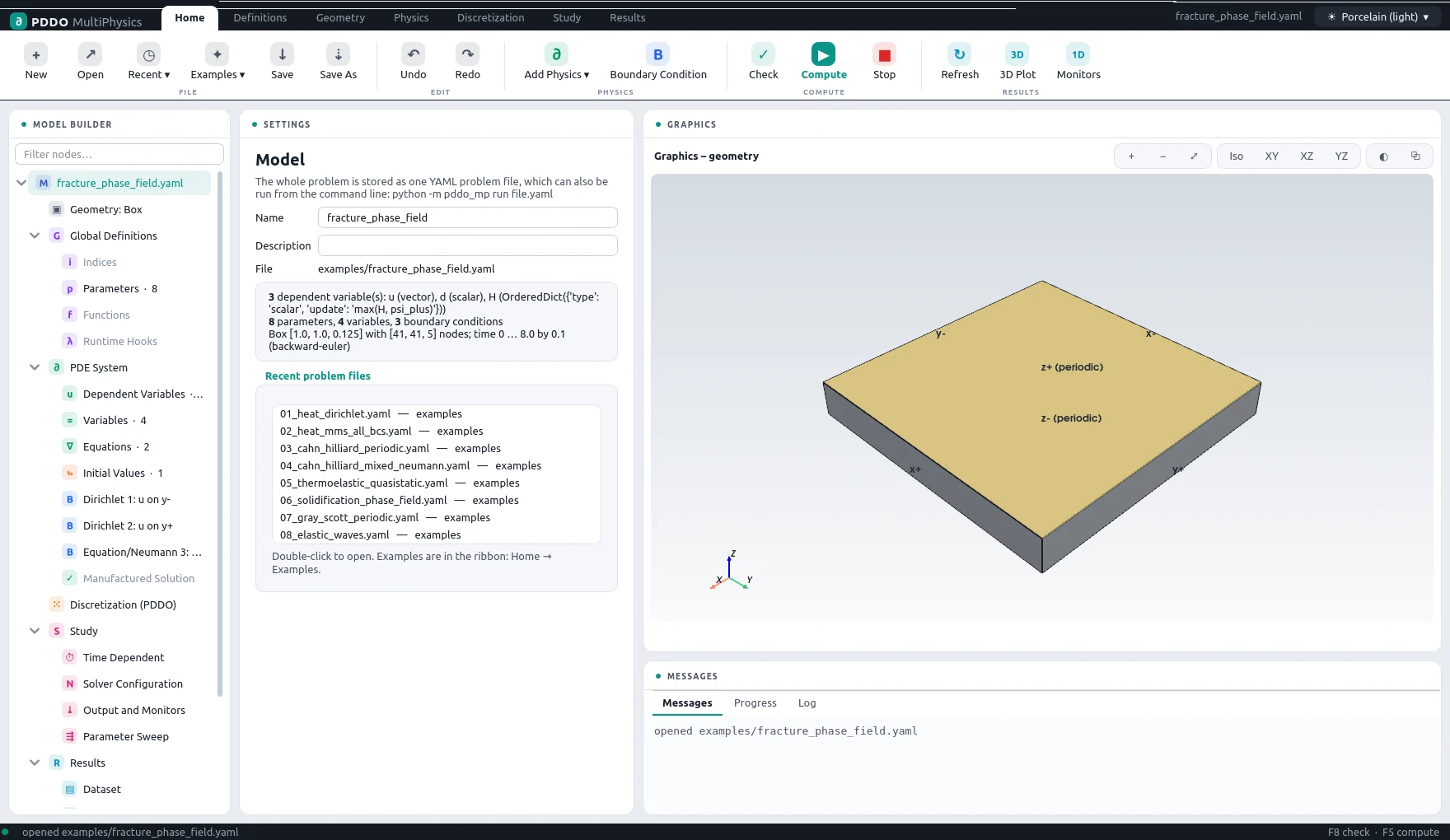
The problem file ships with PDDO-MultiPhysics. Open it in the graphical interface and press Compute, or run it from the command line:
python -m pddo_mp gui examples/fracture_phase_field.yaml
python -m pddo_mp run examples/fracture_phase_field.yaml
Results go to results/fracture_phase_field/
next to the problem file: a ParaView time series (.pvd), the monitors as CSV, and the
final state. Any entry can be changed on the command line, for example
--set time.end=4 for a run to half the end time. The user manual
describes every part of the problem file and of the interface.